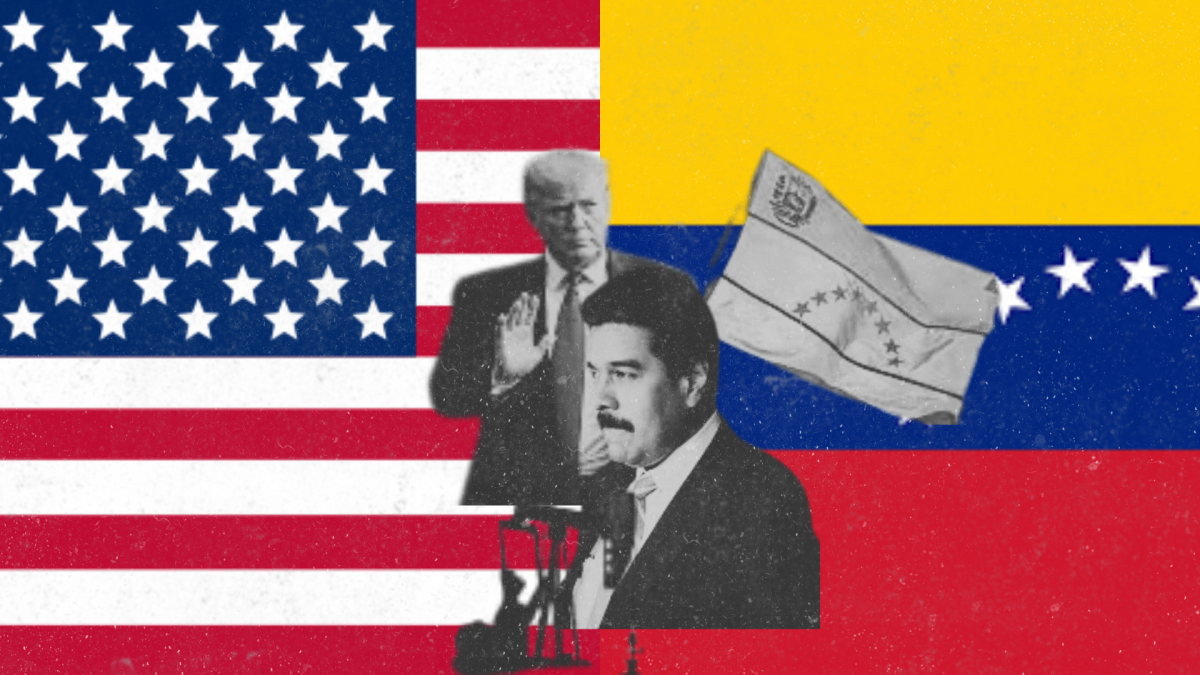
Despite capturing Venezuelan President Nicolás Maduro last month on Jan. 3, the United States has still not presented a clear plan forward. Critics contend that the intervention has weakened America’s reputation abroad without guaranteeing long-term benefits at home. Nevertheless, the United States must uphold its values in global affairs, and should accordingly promote a democratic transition in Venezuela.
Years of escalation and strained tensions have culminated in Maduro’s capture. During his first term, President Donald Trump accused Venezuela of trafficking cocaine into the United States, and charged Maduro for leading drug trafficking efforts, according to the Council on Foreign Relations. Maduro is currently in New York, where he is awaiting trial on charges related to narcoterrorism and weapon possession, a move that has further complicated Venezuela’s political situation.
Representatives from U.S. allies including France, Spain and Denmark voiced that the intervention violated the United Nations charter, while U.N. Secretary-General Antonio Guterres said that he is “deeply concerned” that international law has not been respected, according to BBC News. The consequent impact involves diminished U.S. global standing, which has only been exacerbated throughout January.
As Venezuela is being investigated by the International Court of Justice for crimes against humanity, the intervention may send a warning message to human rights violators; however, global stability will be worse off due to diminished legitimacy of international law, according to Model United Nations co-president and senior Alex Lingerfelt.
“Global stability can be impacted by this intervention, and probably not for the better,” Lingerfelt said. “Though human rights violators could be a little more worried [about] intervention, at the same time, you have the other great powers on the U.N. Security Council, such as Russia and China, looking at this breach of international law, and they could be even further emboldened by such. Or even here in America, we could be emboldened to intervene more.
Trump said that the United States will “run” Venezuela for the time being, while American oil companies step in to fix Venezuela’s oil infrastructure, but it remains unclear how the United States will “run” the country in the first place. Alternatively, Secretary of State Marco Rubio and Secretary of Defense Pete Hegseth have detailed a three-part plan whose components include “stabilization,” “recovery” and “transition.” Stabilization and recovery will both focus on oil, while recovery will also focus on rebuilding civil society, but neither the details for the “transition” phase nor a timeline has been presented, according to NPR.
Concerning domestic interests, there is no guarantee that the United States will be better off following the intervention. Venezuela’s decaying oil infrastructure is the result of decades of mismanagement and underinvestment, which offsets the fact that the country holds the world’s largest proven oil reserves. Presently, Venezuela’s oil output accounts for less than 1% of global oil consumption. Fixing the infrastructure may warrant up to a decade and tens of billions of dollars of investment while political uncertainty in Venezuela still remains a concern for oil companies, according to BBC News.
Without a guaranteed long-term benefit, the intervention has diminished global stability and weakened the global standing of the United States. What the United States should focus on is instead the betterment of Venezuelan lives, according to Lingerfelt.
“If [the U.S.] goes into Venezuela, exploits the natural resources, and then Venezuela does not get significantly better from intervention, that will act as a precedent and sort of as a ‘I told you so’ from those who oppose Americanism,” Lingerfelt said. “Trying to actually help improve the people’s lives in Venezuela can paint America in a more positive light. But again, that depends on the ‘if’.”
Maduro’s capture has not dramatically restructured Venezuela’s leadership. The country’s Vice President Delcy Rodríguez was sworn in as the interim president on Jan. 5 while previous governance remains intact, according to the Council on Foreign Relations. Coupled with the fact that Trump did not back opposition leader and Nobel Peace Prize laureate María Corina Machado as lacking sufficient support to lead the country, a democratic transition seems unlikely.
Nevertheless, such transition remains possible, but only with significant reform on the part of the Venezuelan government and aid on the part of the United States, according to the Carnegie Endowment for International Peace. Venezuela must restore democratic institutions, establish human rights protections and host free and fair elections, while the United States must cooperate to stabilize the country on both an economic and humanitarian level. To ensure such a transition occurs, the United States has various tools at its disposal. Perhaps aid can be contingent upon political opening. But regardless, by pressuring Rodríguez to act on these reforms, greater representation for the Venezuelan people may eventually be restored.
The intervention in Venezuela must not go down in history as another textbook case of American imperialism. The country is ripe for political change that will bring greater liberty and representation to the Venezuelan people. The United States must act upon this opportunity to promote a democratic transition such that its values of freedom and liberty stay consistent when it goes abroad.