
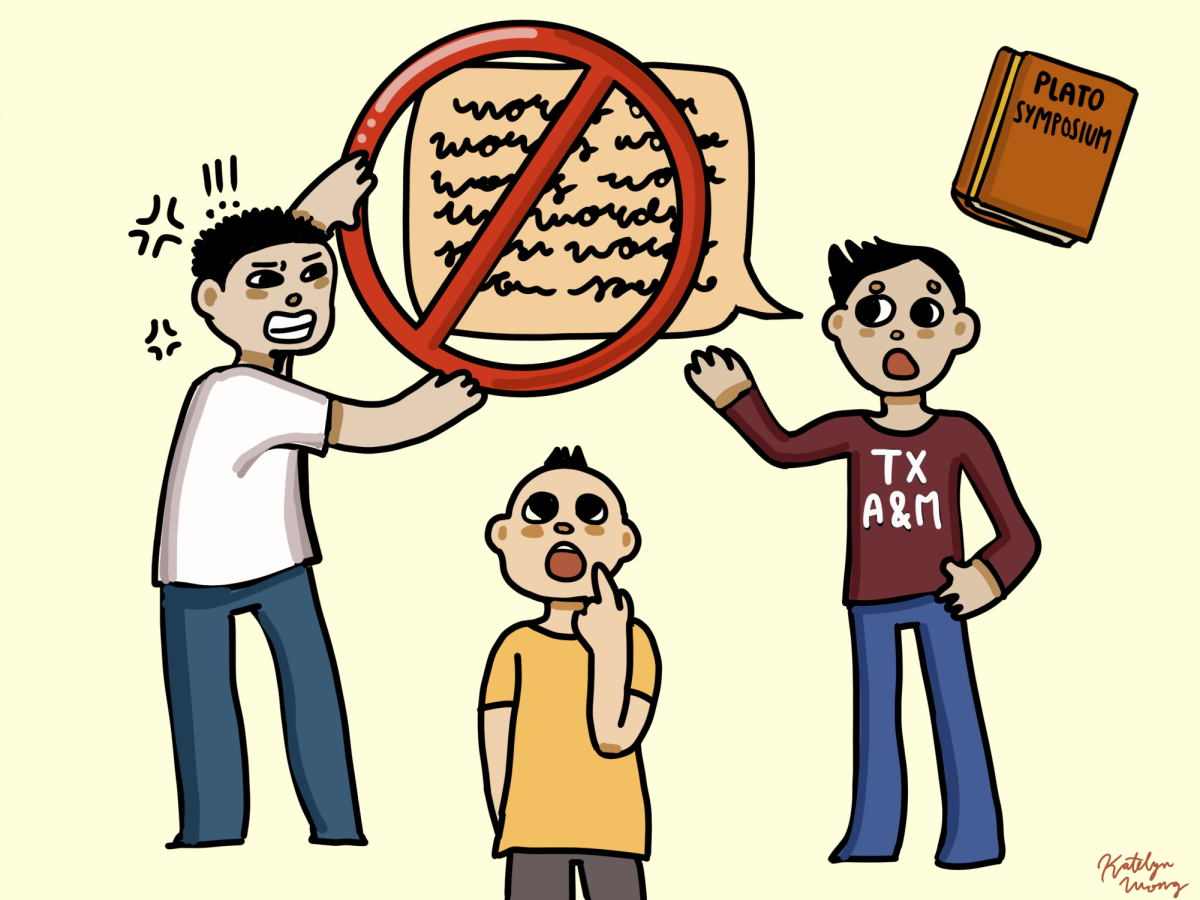
Since the establishment of Plato’s Academy, higher education has aspired to Socrates’ dictum: “the unexamined life is not worth living.” Yet today, the academic freedom of universities is at risk from partisan censorship, which has adopted an increasingly outsized role in classrooms in the eyes of many critics. The mission of universities should not be to promote the ideological dogma of a political camp, but rather universities should foster productive dialogue when it comes to contentious issues.
The year 2025 was marked by an unprecedented wave of censorship on academic and research freedom. Across 32 states, legislators introduced 93 bills, 21 of which would become law, aimed at censoring higher education. These bills included so-called “educational gag orders,” most of which restrict the teaching of “divisive concepts,” including race, gender and sexuality, according to PEN America.
Recently, Texas A&M has sparked outrage for its flagging and cancellation of course content relating to race and gender. A course titled “Contemporary Moral Issues” taught by Professor Martin Peterson was flagged due to its inclusion of Plato’s “Symposium,” which includes a passage discussing the existence of more than two genders and gender identity, according to Inside Higher Ed. Instances such as these, coupled with partisan legislation, replace the opportunity for students to collaborate meaningfully on discussions that explore a wide range of topics. When censorship takes charge, the intellectual diversity of campuses is diminished, and so too is the examination and refinement of our beliefs, according to social studies teacher Jon Resendez.
“You don’t really know your own argument until you know your opponent’s argument,” Resendez said. “Knowing what others argue helps you refine your own ideas and beliefs. And I think that’s a really important part of the process. We might also be very convinced that we’re right when in fact, that we’re wrong. And because we’re fallible, we need other ideas to inspire us to interrogate the truth claims that we’re making. I don’t see any other way of arriving at the truth without being able to compare our ideas to each other.”
Fortunately, censorship is not the only method that exists to solve ideological differences. Open collaboration where all viewpoints are heard and discussed is a better alternative, according to junior Seraphine Chen. Chen works with Braver Angels, a nonprofit focused on bringing both sides of the political spectrum together through productive conversation.
“I think having these environments where students can be collaborative and state their views freely [while] also understanding other perspectives, is more preferable to censorship,” Chen said. “Instead of completely blocking out certain views or certain lessons, people can truly talk out their perspectives to learn about other perspectives, even if they don’t necessarily agree with them.”
However, critics contend that higher education often embraces a left-wing bias, with conservative viewpoints facing rejection on college campuses. This criticism is not unfounded, as the liberal to conservative faculty ratio rose from 2-to-1 in 1995 to more than 6-to-1 in 2019, according to City Journal. In addition, nearly 70% of conservative students fear social repercussions for expressing their viewpoints, according to the Young America’s Foundation.
While intellectual homogeneity is a pertinent issue in higher education, censorship is not the answer. Changes within college campuses are necessary to encourage viewpoint diversity, but directly censoring viewpoints will not create the thoughtful and diverse environment that campuses need. The death of the philosophical project will not be the result of the triumph of science or its growing irrelevance, but rather the policies and censors that replace genuine collaboration with political indoctrination. If the unexamined life is truly not worth living, then partisan censorship must stay out of higher education.