

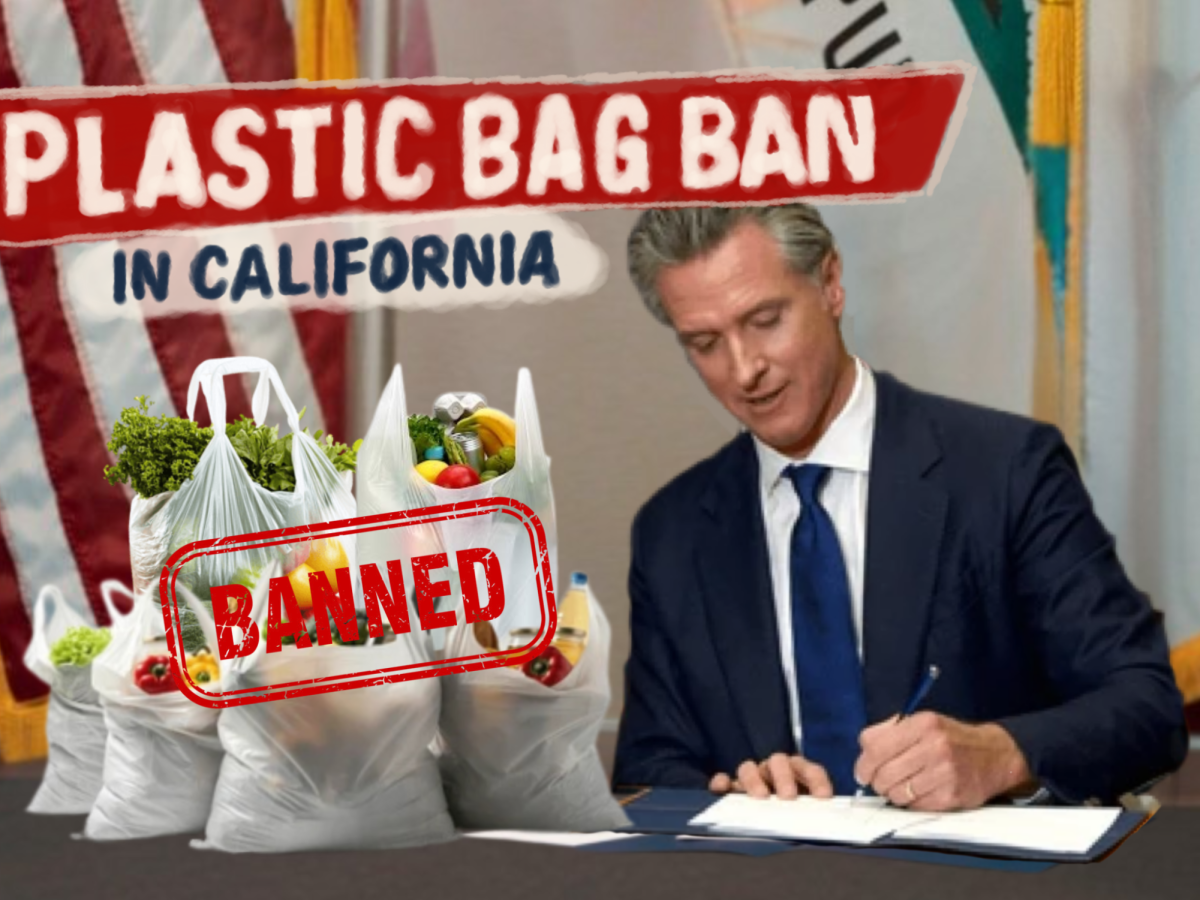
California has passed SB 1053, a law banning the distribution of plastic grocery bags at retail checkout counters starting Jan. 1. This policy requires shoppers to bring their own reusable bags or purchase a paper bag for a 10-cent fee.
Plastic bags have long posed a problem due to their lack of reusability and long-term impact on ecosystems. Plastic waste accumulating in the ocean is projected to outweigh the number of fish by 2050, according to The Center for Biological Diversity. In the U.S., about 32.1% of waste is recycled or composted, according to California Management Review.
“In terms of the environmental impact, it should definitely make a big impact in a positive way, because now people won’t have [plastic bags] as much,” AP Environmental Science teacher Courtney Moder said. “In order to recycle plastic bags, you have to actually bring them back to a store to recycle. I’ve never been able to manage to collect enough [plastic bags] to bring them back to the store and actually follow through with [recycling]. And I’m sure that’s pretty common for most people.”
This ban has already shown signs of effectiveness, with 60% of voters from a poll supporting the plastic bag ban, according to the Los Angeles Times. Shoppers can easily adapt to this change by investing in reusable bags that are inexpensive and widely available. By encouraging this behavioral change, the ban promotes sustainable habits and helps reduce long-term environmental harm.
“Our family actually has a lot of reusable bags from Trader Joe’s,” Animal Environmental Protection Club member and junior Benjamin Kim said. “I feel like it is a bit more convenient to use reusable bags, because sometimes plastic bags can rip, and they’re pretty fragile. I think it might change some mindsets as well about using reusable bags instead of plastic ones, and help them see all the benefits that can come with it.”
On the other hand, some argue that the plastic bag ban will not be effective in reducing waste, claiming that when consumers stop receiving free plastic bags at checkout, they switch to buying them in other forms, such as plastic trash bags, according to Chicago Booth Review.
“Even if you can’t purchase a bag at the retailer, you could theoretically buy a box of plastic bags at Costco or somewhere,” Moder said. “So it’s not that they won’t be available and they won’t still be floating around, but hopefully it will minimize the amount that are more available to purchase. If people still really wanted those plastic bags, they still have access to them. It’s just they have to maybe take another step to get them.”
While this may hold true, the ban still reduces casual and excessive use. California is the most populous state, serving as a model for other states to follow. With future requirements for paper bags to contain 50% recycled material by 2028 and plans to create single-use packaging by 2032, policymakers must commit to supporting these measures to push California towards a more sustainable future.