


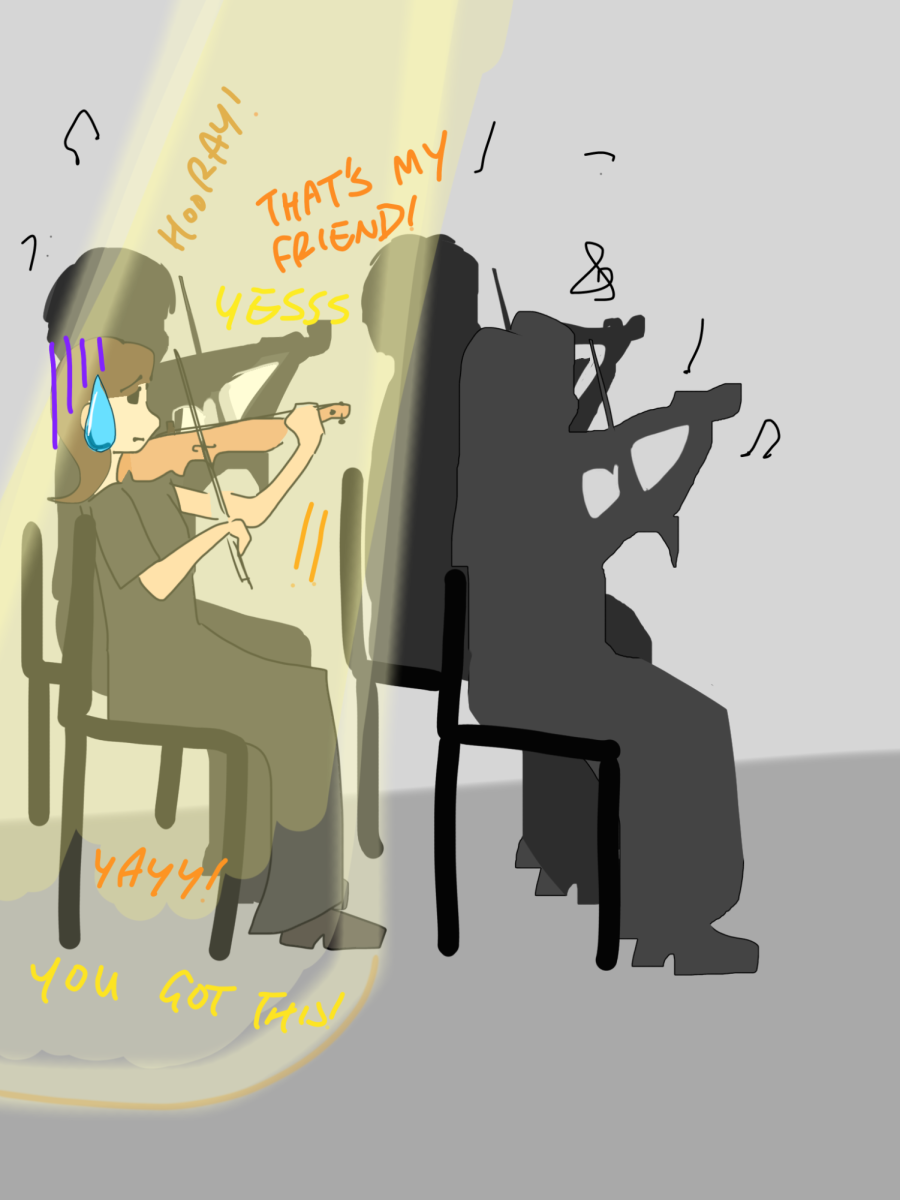
You leave a concert with a bad taste in your mouth. It wasn’t the music — it was the cacophony of poorly timed cheers around you during the show. Students should inform themselves on proper concert atmosphere before attending an instrumental concert.
Instrumental performers spend months preparing for performances throughout the year — participating in rehearsals that last three to four hours — to give the audience the most enjoyable experience possible, according to sophomore and philharmonic orchestra violinist Audrey Lee. However, many audience members cheer wildly at inappropriate times during the concert.
“In orchestra, I’m coming onto stage with the rest of the orchestra, and I hear a bunch of people, and typically students are seated in the balcony, so it’s higher up and everybody can hear it, yelling my name,” senior Noa Stewart, a Philharmonic Orchestra string bassist and studio music electric bassist, said.
Poor concert etiquette is usually not displayed out of malice. Most cheers are shouted in genuine support, according to Stewart. But instances like calling out a friend’s name as they walk on stage does occur.
“During our orchestral concerts, as performers are walking onto stage, instead of applauding, [audience members] will yell friends’ names or be overly loud,” Stewart said. “Of course, it’s all in support, but it’s not what’s expected in a professional venue.”
Even in earnest support, poorly timed applause is damaging to performers and fellow audience members. Yelling an individual’s name, for example, can add pressure onstage and disrupt the atmosphere, according to instrumental music director Desmond Stevens.
“The music itself is the thing that we’re honoring,” Stevens said. “We’re not generally honoring an individual or a group, and that’s the reason why orchestras wear all black or a tuxedo and a dress, because we’re trying to take the individual out of it as much as possible.”
For pop music as well, showing respect by reading the room at a concert is an essential part of a concert that appeals to the whole audience, according to Stewart.
“There are mosh pits that start going but it’s still, at the end of the day, a high school concert, so you have to stay cordial,” Stewart said. “It’s meant for families and students to interact. So you can’t be doing anything dangerous or something you wouldn’t want your family to see.”
Some may argue that concert etiquette is neither known nor widely taught enough to expect an audience to be perfectly educated on it. Most poor etiquette is the result of an innocent lack of knowledge in an attempt to show support for peers, according to Stewart. However, even in genuine support, encouragement should remain respectful, according to Lee. To appropriately express support, students should learn and educate their peers on proper etiquette.
“It could just be peers telling each other how to behave at concerts,” Stewart said. “Starting from each level, from students, educating peers, directors, educating students and parents.”
Ultimately, even with good intentions, students should educate themselves by learning from their performer friends and spreading knowledge on how to read the room and behave appropriately at a concert to keep the performance enjoyable.