

California voters passed Proposition 50, an amendment to the California State Constitution to temporarily redraw congressional districts, in a special election ballot on Nov. 4.
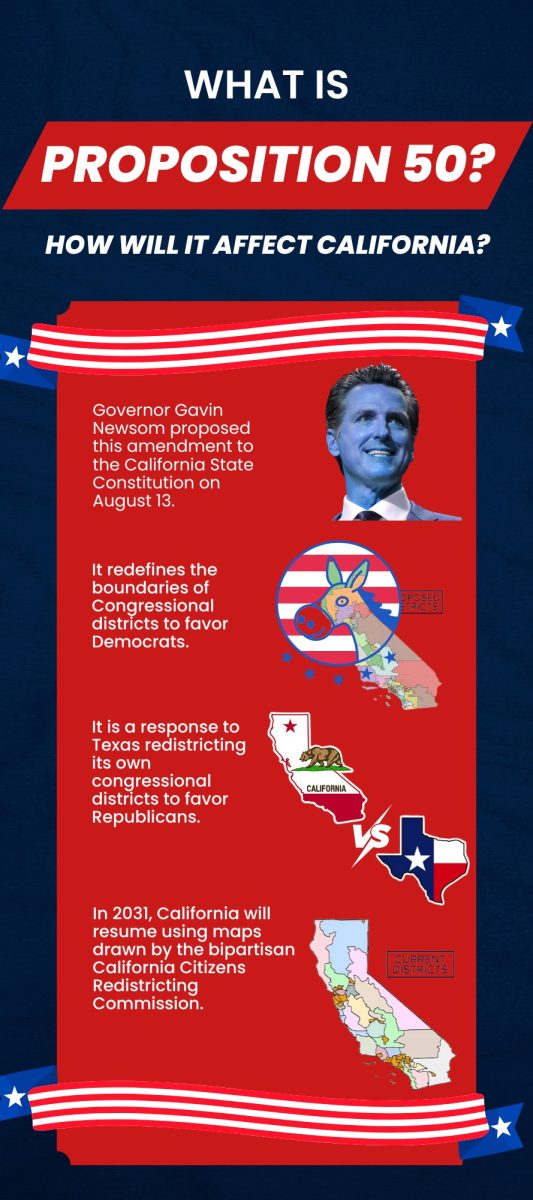
Proposition 50, also known as the Election Rigging Response Act, requires California congressional districts to adopt new legislature-drawn maps from 2026 through 2030, whereafter the state will resume using non-partisan maps drawn by an independent commission, according to the California Voter Information Guide.
Redrawn districts favor the Democratic Party’s candidates in California, as Governor Gavin Newsom first proposed the amendment as a countermeasure to Texas Republican lawmakers’ gerrymandering to favor Republican candidates, according to CalMatters.
“California’s response was that we were going to do this in order to tip the scales back the way they were before Texas did their redistricting,” AP Government teacher Megan Saia said. “A lot of California voters who voted for Prop 50 also expressed that they would prefer an end to gerrymandering throughout the whole country. This seemed to be more of a response to the other side redistricting, rather than a rejection of independent districting as a whole.”
California Democrats advocated for the amendment to retaliate against the Trump administration’s deportation of undocumented immigrants and other pro-Republican political maneuvers. Less than twenty four hours after voting concluded, California Republicans launched a lawsuit contesting the constitutionality of Proposition 50, alleging that it violates the 14th and 15th Amendments because it unfairly favors Latino voters over other ethnic groups, according to California Courts Newsroom.
“The new map relies on 2020 census data, which can be seen as outdated, since population patterns change quickly in California,” sophomore Sara Chang stated. “So some districts hold more people than others, and this creates unequal representation.”
State elections affect Californians of all ages, including minors ineligible to vote, according to Saia. Students unable to vote can still volunteer in political campaigns by canvassing and cold-calling.
“Whether or not [students] are 18 and are registered to vote, they’re still going to be impacted by who their congressional representative is,” Saia said. “Hopefully, it shows that the things, the decisions that the voters in California make and the national voters make have a real impact on their day-to-day lives.”
The Supreme Court is currently examining the landmark court case Louisiana v. Callain, which challenges Louisiana’s congressional redistricting map and Section 2 of the Voting Rights Act. If ruled unconstitutional, the case could void Proposition 50 maps. Following the 2030 census, California will return to maps drawn by the bipartisan California Citizens Redistricting Commission in 2031.