


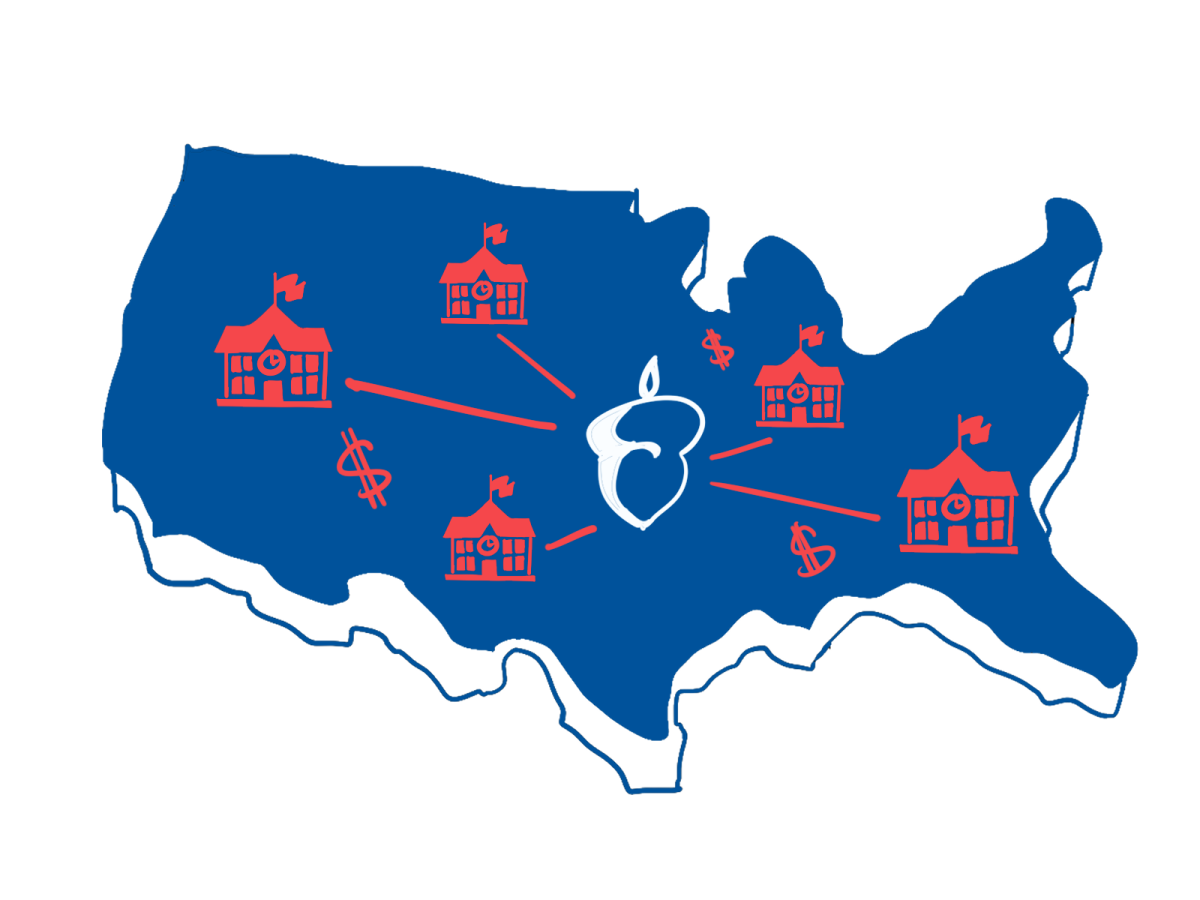
Since 1899, the College Board has been a major stakeholder in American education, serving 23,000 public high schools. The College Board’s founding mission is to expand student access to higher education through standardized tests (SAT, PSAT and AP). However, controversies over rising fees, ancillary score report charges, educator wages and excessive lobbying have called into question whether the institution is adhering to its original mission.
Realistically, there is currently no viable alternative to the nationwide standardization offered by the College Board system, since education is an issue largely left up to individual states. Yet even if it is a necessary institution, the College Board must take steps to better serve students and teachers by decreasing standardized test fees and adjusting AP reader hourly rates.
When considering potential alternatives to SAT and AP (test-optional, test-blind and dual-credit systems), the dilemma that arises is one of equity versus fairness. On one hand, standardized tests favor traditionally high socioeconomic status (SES) populations, where a family of means has greater access to well-funded schools, tutors, and time compared to lower SES populations, according to AP coordinator and Assistant Principal Steven Chai. Even so, APs are important for their ability to standardize. Without standardized scores, it is impossible to know if a student in Portola who earns an A has the same subject mastery as a student in Kentucky, and teachers would struggle to assess the objective difficulty of their class.
“When University of California got away from SAT as an admission requirement, they were actually supposed to, by this year, create a replacement for that standardization,” Chai said. “But that’s been suspended because they couldn’t think of a better system. You see, University of Michigan, Texas, Pennsylvania, Florida, when those big state school systems start requiring something different, is when you’ll see some change. But I don’t see [an alternative].”
However, a major barrier for students is the cost of each AP test: $99 for domestic and $129 for overseas students. Even with exam fee subsidies for low-income students, racial and socioeconomic disparities are still exacerbated through such fees. In Delaware, only 33% of Black students enrolled in AP courses completed the AP exam, compared to 59% and 84% of white and Asian students, according to Urban Institute. For senior Driti Rajkumar, who has taken six AP tests and the SAT multiple times, the yearly amount she pays to the College Board simply does not seem justified.
“Now that [the SAT] is digital and most of our AP tests are digital, I feel that there’s not much of a need for there to be such high cost,” Rajkumar said. “Even considering that I know they have employees working for College Board, the costs seem to be too much, especially when it starts adding up.”
Despite AP tests and SATs transitioning from paper to the Bluebook app, fees have risen an average of 1% each year since 2020. Since the digital transition period has already ended, base test fees should substantially decrease, and low-income students should be qualified for more than 2 free SATs, especially since tests no longer need to be printed and shipped.
Additionally, for AP readers who voluntarily grade AP tests over the summer, the compensation rate is $30 per hour. Before grading, each AP reader is taught the software for two hours, trained on the rubric for six hours, and put under the supervision of a table leader who has had an additional week of training. Despite the grading being a valuable learning opportunity for teachers, the hourly rate should increase to match the skill level demanded of graders, according to math teacher and long-time AP grader Eric Graham.
“In IUSD, we’re paid an additional $40 to $45 dollars an hour when we have additional work to do,” Graham said. “I would get paid $40 an hour to do Saturday school right, and that really takes no skills. [The AP reader rate] used to be $25 when I first started, and so it already went up to $30, but with how much is being charged for tests and how much administrators of the College Board make, I think they could definitely pay us a little bit more.”
Traditionally, most proponents of the College Board system argue that the cost accrued by taking AP tests are vastly preferable to a typical college course, which can rack up to the thousands, according to Chai.
However, a major issue with the AP system is that AP credits do not translate uniformly to all colleges, according to CNBC. One school could require a score of five to count as credit whereas another may only require a three — highly selective schools like Dartmouth or Brown don’t offer course credit at all and only use AP scores for course placement. Additionally, several schools, like Highland Park High School in Texas, make AP testing mandatory for an AP class, forcing students to incur costs against their will. Reducing AP test fees or making them free entirely could mean the difference for thousands of students.
In the aftermath of massive cuts to the Department of Education and increased federal scrutiny towards public schools, the last thing we should be doing is locking education behind fees.